MicroSwim Analyzer: Open-Source Real-Time Tracking for Microorganism Motility Research
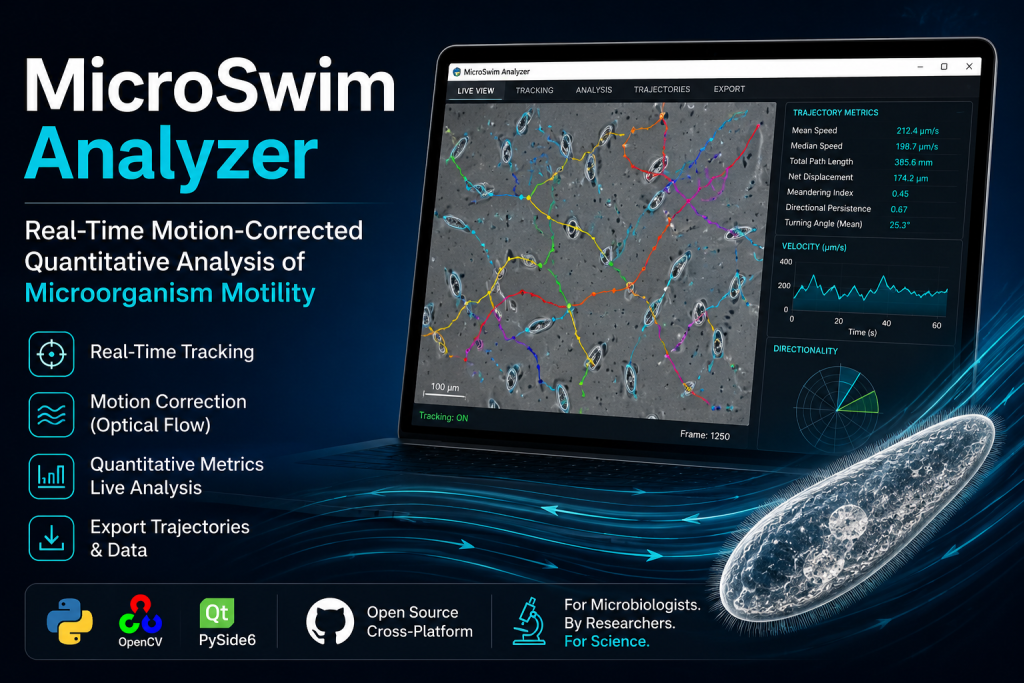
Quantitative analysis of microorganism movement plays an important role across many areas of biology, including microbiology, electrophysiology, toxicology, biofluid mechanics, behavioral analysis, and environmental sensing. Yet despite advances in microscopy imaging, many laboratories still rely on manual observation, proprietary software, or offline analysis pipelines that can be difficult to reproduce and expensive to access.
MicroSwim Analyzer was developed to help address these challenges by providing a fully open-source platform for real-time motion-corrected microorganism tracking and quantitative trajectory analysis.
What Is MicroSwim Analyzer?
MicroSwim Analyzer is a Python-based microscopy analysis application designed for tracking freely swimming microorganisms in two-dimensional video microscopy recordings.
The software combines:
- Real-time object tracking
- Optical-flow-based motion correction
- Live kinematic analysis
- Interactive visualization
- Quantitative trajectory export
within a single graphical interface.
The platform was designed specifically for transmitted-light microscopy conditions, where illumination variability, stage drift, and manual microscope repositioning can complicate reliable trajectory reconstruction.
Why Motion Correction Matters
One of the most common problems in microorganism motility experiments is unintended camera or microscope-stage movement.
Even small mechanical vibrations or manual stage adjustments can distort measured trajectories and produce misleading estimates of:
- Swimming speed
- Directional persistence
- Path geometry
- Turning behavior
- Net displacement
MicroSwim Analyzer addresses this problem using optical-flow-based background motion estimation. The software continuously estimates global camera displacement and compensates for it computationally during tracking.
This allows researchers to better separate true organism behavior from microscope motion artifacts.
Real-Time Quantitative Metrics
The software computes a range of biologically relevant motility metrics during live tracking, including:
- Instantaneous velocity
- Mean and median speed
- Total path length
- Net displacement
- Turning-angle statistics
- Directional persistence
- Meandering index
- Field-aligned velocity components
- Directional alignment
These measurements are updated continuously during analysis and can be exported for downstream statistical processing.
Applications in Biological Research
MicroSwim Analyzer may be useful in a broad range of experimental and educational contexts, including:
Electrophysiology and Galvanotaxis
The software includes field-oriented trajectory analysis tools that can help quantify directional responses under externally applied electric fields.
Chemotaxis and Environmental Response Assays
Researchers studying chemical gradients or behavioral adaptation can use the platform to quantify directional persistence and movement bias.
Toxicology and Drug Screening
Changes in microorganism motility are frequently used as indicators of toxicity or physiological stress. Automated quantitative analysis can improve reproducibility and throughput.
Ciliary and Protozoan Motility Studies
The platform is particularly suitable for freely swimming microorganisms such as Paramecium and other ciliated organisms commonly used in electrophysiological and behavioral research.
Educational Microscopy
Because the software is open-source and cross-platform, it may also be valuable in teaching laboratories and low-cost microscopy environments.
Open-Source and Extensible
MicroSwim Analyzer was implemented entirely using open-source scientific Python tools, including:
- OpenCV
- NumPy
- pandas
- PySide6
- pyqtgraph
The modular architecture allows future expansion toward:
- Multi-object tracking
- Machine-learning-assisted segmentation
- Fluorescence-compatible workflows
- GPU acceleration
- Three-dimensional tracking
- Automated behavioral classification
Validation and Reliability
To evaluate tracking accuracy under controlled conditions, a synthetic validation framework was developed to generate microscopy-like videos with analytically known trajectories and simulated camera motion.
Validation experiments demonstrated:
- Stable tracking continuity
- Accurate large-scale trajectory reconstruction
- Effective compensation of translational camera drift
- Robust performance under delayed camera-follow conditions and positional jitter
These tests provide quantitative evidence that the software can maintain reliable tracking under realistic microscopy instability conditions.
Accessibility and Reproducibility
A central goal of the project is to improve accessibility to quantitative microscopy analysis tools.
Many existing solutions depend on proprietary ecosystems or specialized hardware configurations. By contrast, MicroSwim Analyzer was designed to be:
- Open-source
- Cross-platform
- Reproducible
- Extensible
- Accessible to independent researchers and small laboratories
Availability
The software source code, releases, and documentation are openly available online.
GitHub repository:
https://github.com/igornelson5git/microswim-analyzer
Archived releases:
https://doi.org/10.5281/zenodo.20135283
Final Thoughts
Quantitative analysis of microorganism behavior is becoming increasingly important across modern biological research. By combining real-time tracking, motion correction, and trajectory analysis within an accessible open-source framework, MicroSwim Analyzer aims to provide researchers with practical tools for reproducible microscopy-based motility analysis.
The project is ongoing, and future improvements, feedback, and community contributions are welcome.
[SBYeast] Subtle Bioenergy on Yeast Growth and Viability

Exploring the influence of Schumann resonance and electromagnetic fields on bioelectricity and human health

[FPolarity] Magnetic North and South Polarity on Microorganism Proliferation and Motility
About The Author
