Do Manectic Poles Relate with Gender?
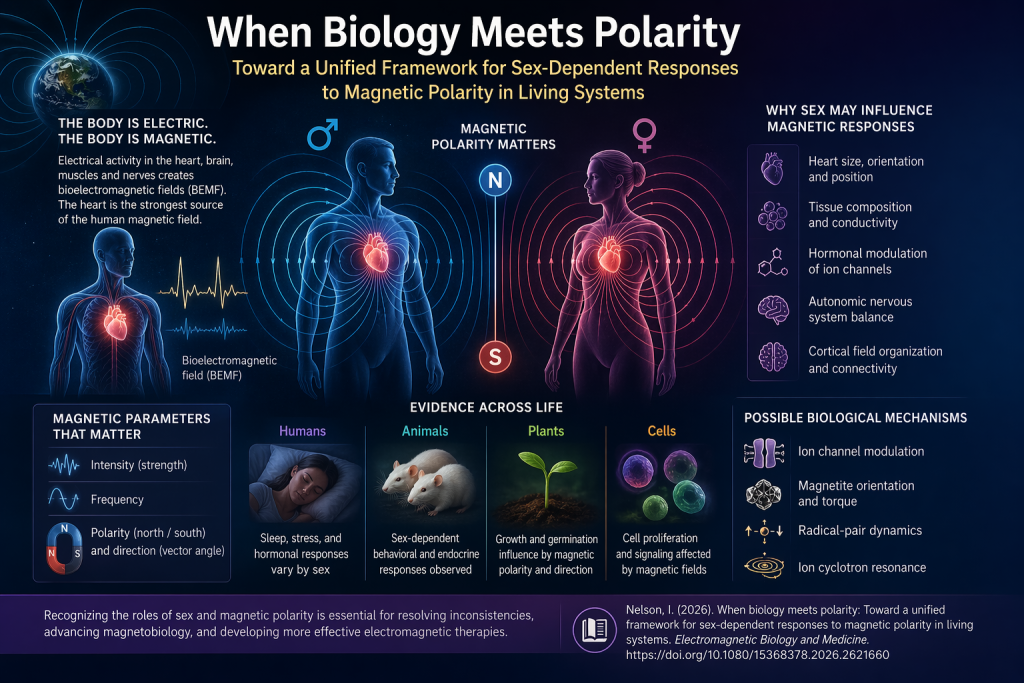
Magnetic fields surround us constantly. The Earth itself generates one, and humans encounter many more through technology—from household wiring to medical devices such as MRI scanners and transcranial magnetic stimulation.
But an overlooked question is beginning to emerge:
Do men and women respond to magnetic fields in the same way?
A recent review proposes that the answer may be more complicated than scientists once assumed. It suggests that biological sex could play an important role in how living systems respond not only to magnetic field strength or frequency, but also to magnetic polarity—whether the north or south pole faces the body.
The Body Is Electrically Active
The human body is not electrically silent.
Every heartbeat is driven by synchronized electrical currents. The brain communicates through electrochemical signaling. Muscles and nerves generate measurable electrical activity as well.
These processes create tiny magnetic fields around the body. In fact, the heart produces the strongest biological magnetic field in humans, detectable with sensitive instruments such as SQUID magnetometers.
This means the body does not merely receive electromagnetic influences—it also generates its own.
Why Sex Might Matter
Although the underlying biology is shared, male and female physiology differs in several important ways that could influence magnetic interactions.
These include:
- average heart size and orientation
- thoracic anatomy
- muscle and fat distribution
- tissue conductivity
- hormonal regulation of ion channels
- autonomic nervous system balance
- patterns of brain connectivity
Each of these factors may subtly shape the body’s internal electromagnetic environment.
In other words, two people exposed to the same magnetic field may not experience exactly the same biological conditions.
What Studies Have Found
Some experiments have reported sex-specific responses to magnetic exposure.
Examples cited in the review include:
- sleep and heart-rate variability changes differing between men and women under low-frequency magnetic exposure
- female rats showing stronger behavioral responses than males under strong static magnetic fields
- reproductive hormone changes occurring differently in male and female animals
- differing responses to transcranial magnetic stimulation depending on sex and hormonal state
None of these findings alone settle the question. But together, they suggest sex is a variable that deserves greater attention.
The Overlooked Variable: Polarity
Many studies focus on how strong a magnetic field is. Far fewer report polarity—whether the north or south pole faces the organism—or the exact direction of the field in space.
That may be a mistake.
The review highlights evidence that living systems can respond differently depending on magnetic orientation. In plants, for example, root growth and germination have sometimes varied depending on field direction. Human brain studies have also shown measurable responses to Earth-strength rotating magnetic fields under specific polarity conditions.
If polarity matters, then failing to report it could help explain why studies sometimes produce inconsistent results.
A New Hypothesis
The article proposes a broader framework:
Biological sex may define different boundary conditions for how magnetic polarity interacts with living systems.
Possible mechanisms include:
- hormone-dependent ion channel behavior
- differences in tissue electrical properties
- radical-pair reactions (a candidate mechanism for magnetoreception)
- structural asymmetries in anatomy or magnetic particles such as magnetite
These ideas remain hypotheses—but testable ones.
Why This Matters
If confirmed, the implications could be significant.
Future applications might include:
- more personalized magnetic therapies
- improved transcranial stimulation protocols
- better reproductive and endocrine research
- stronger standards for electromagnetic exposure studies
- clearer understanding of contradictory past findings
In short, biology may be more context-dependent than assumed.
Science Advances by Asking Better Questions
For years, magnetic biology has often focused on intensity and frequency.
But what if two other variables—sex and polarity—have been hiding in plain sight?
Sometimes progress in science does not begin with new technology. It begins by noticing what previous experiments forgot to measure.
Author Note
Based on the peer-reviewed article:
Nelson, I. (2026). When biology meets polarity: Toward a unified framework for sex-dependent responses to magnetic polarity in living systems. Electromagnetic Biology and Medicine. Advance online publication. https://doi.org/10.1080/15368378.2026.2621660

EEG Patterns During Meditation and Mental Activity — What I Discovered in My Own Brain
Measuring Electric Syntropy in Biosignals: A Harmonic Proportionality Approach to EEG and ECG Analysis

How to Properly Calibrate Your Arduino pH Sensor
About The Author
