[ParaMot] Low-Frequency Electromagnetic Fields and Paramecium spp. Motility
Abstract
Electromagnetic fields (EMFs) are an increasingly prevalent component of modern environments and have been shown to influence a range of biological processes across microbial, plant, and animal systems. Protozoa such as Paramecium spp. provide a valuable model for studying cellular responses to environmental stimuli due to their well-characterized motility, membrane excitability, and sensitivity to ionic and electrical gradients.
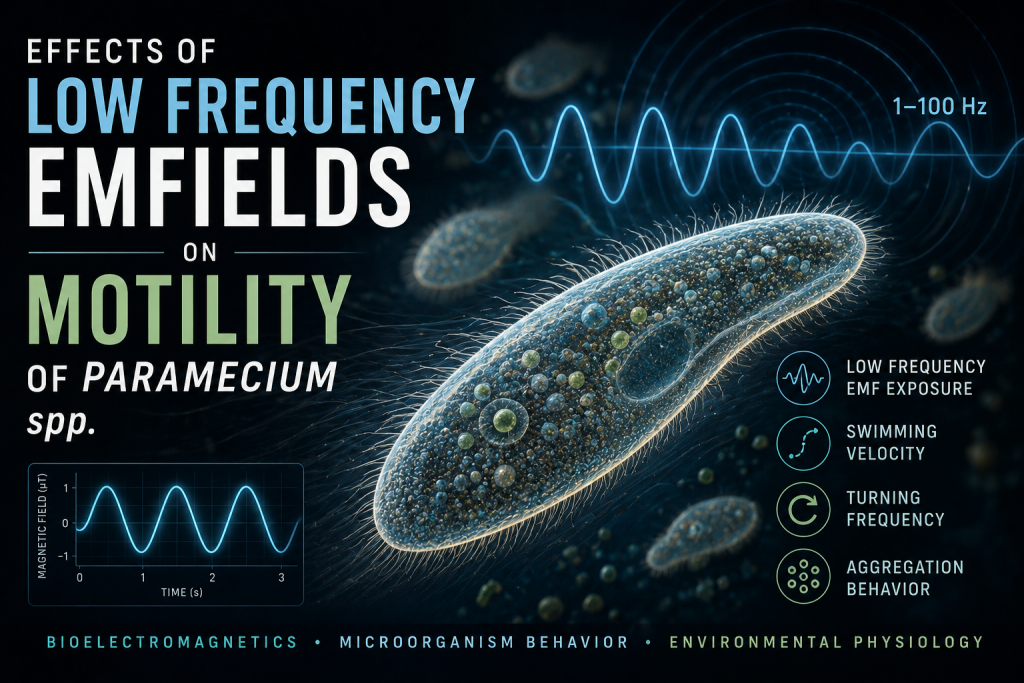
This study investigates the effects of low-frequency electromagnetic fields (LF-EMFs) on the motility behavior of Paramecium populations under controlled laboratory conditions. Cultures of Paramecium caudatum will be exposed to sinusoidal electromagnetic fields within the 1–100 Hz range at varying field strengths, alongside sham-exposed controls. Behavioral parameters including swimming velocity, directional persistence, turning frequency, and aggregation dynamics will be quantified using video microscopy and automated motion-tracking analysis.
Previous studies have demonstrated that electromagnetic exposure can alter membrane permeability, calcium ion transport, and cellular signaling pathways in both unicellular and multicellular organisms. In ciliates specifically, external electromagnetic and magnetic field conditions have been associated with measurable changes in swimming orientation and behavioral activity, potentially mediated through ion-channel regulation and electrophysiological mechanisms.
We hypothesize that LF-EMF exposure may induce measurable alterations in Paramecium motility through modulation of membrane excitability and calcium-dependent signaling pathways. Understanding these interactions may contribute to broader research in bioelectromagnetics, environmental physiology, and cellular adaptive behavior.
This work aims to establish a reproducible experimental framework for assessing electromagnetic effects on microorganism behavior and to evaluate whether weak environmental electromagnetic conditions can influence motility patterns in simple eukaryotic systems.
References
Dihel, L. E. (1985). Effects of an extremely low frequency electromagnetic field on cell division in Paramecium. Bioelectromagnetics, 6(1), 1–5.
Foletti, A., Grimaldi, S., Lisi, A., Ledda, M., Liboff, A. R. (2013). Bioelectromagnetic medicine: The role of resonance signaling. Electromagnetic Biology and Medicine, 32(4), 484–499.
Martel, J. (2024). Effects of light, electromagnetic fields, and water on Paramecium behavior. Progress in Biophysics and Molecular Biology, 186, 12–20.
Pilla, A. A. (2013). Electromagnetic fields instantaneously modulate nitric oxide signaling in challenged biological systems. Biochemical and Biophysical Research Communications, 426(3), 330–333.
Rosen, A. D. (2003). Mechanism of action of moderate-intensity static magnetic fields on biological systems. Cellular Biochemistry and Biophysics, 39(2), 163–173.
Shimizu, K., & Kato, M. (1999). Effects of magnetic fields on microorganisms. IEEE Transactions on Magnetics, 35(5), 5008–5010.

Do Weak Electromagnetic Fields Help Plants Grow?

How to Properly Calibrate Your Arduino pH Sensor

Measuring Electric Syntropy in Biosignals: A Harmonic Proportionality Approach to EEG and ECG Analysis
About The Author
