Measuring Electric Syntropy in Biosignals: A Harmonic Proportionality Approach to EEG and ECG Analysis
Abstract
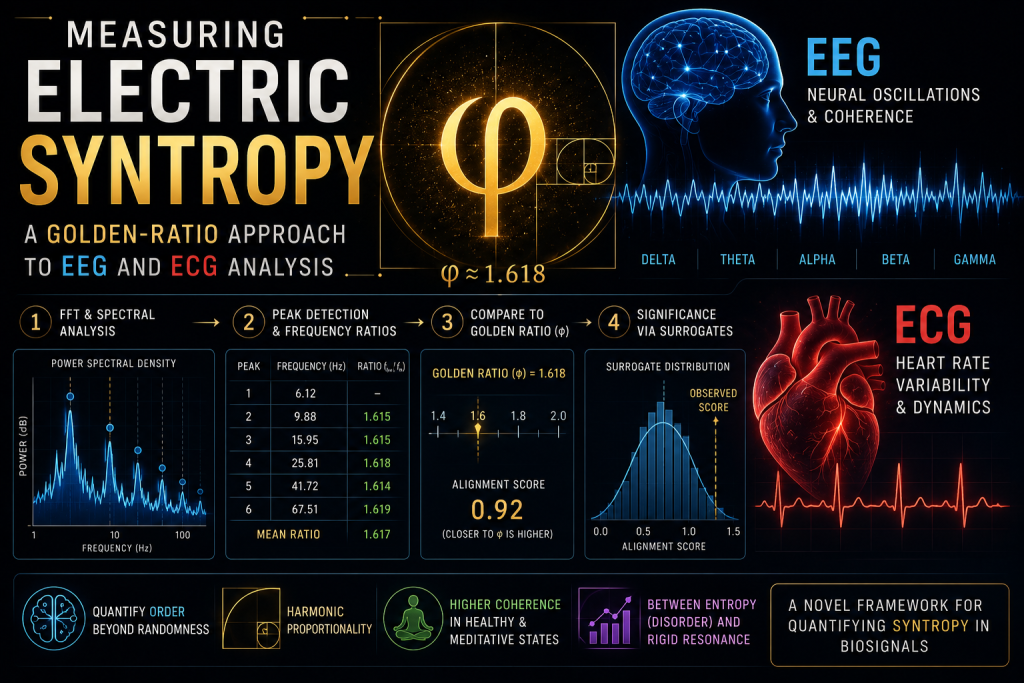
Biological systems exhibit complex electrical dynamics that are commonly characterized using entropy, spectral analysis, and nonlinear complexity metrics. While entropy-based approaches quantify disorder and unpredictability, comparatively fewer frameworks attempt to quantify structured harmonic organization within biosignals. Inspired by Luigi Fantappiè’s concept of syntropy and Schrödinger’s notion of negentropy as an organizing principle in living systems, this project proposes a novel signal-analysis framework for evaluating harmonic proportionality in electroencephalographic (EEG) and electrocardiographic (ECG) signals.
The proposed method applies fast Fourier transform (FFT) analysis to biosignal recordings in order to identify dominant spectral peaks and calculate ratios between consecutive frequency components. These ratios are then compared against the golden ratio (φ ≈ 1.618), which has been hypothesized in various natural systems as a potential marker of scale-invariant organization and harmonic structuring. A proportionality index is computed using a distance metric quantifying deviation from φ-aligned relationships within the spectral hierarchy.
To assess statistical significance, surrogate datasets generated through phase randomization and spectral-preserving shuffling are used as null models for comparison against experimentally observed signals. Visualization outputs include power spectral density distributions, peak-ratio mappings, surrogate probability distributions, and harmonic proportionality heatmaps.
Preliminary theoretical considerations suggest that physiological states associated with elevated coherence—such as high heart rate variability (HRV), meditative states, or synchronized neural oscillations—may exhibit increased harmonic proportionality relative to randomized controls. Unlike conventional entropy measures, which primarily quantify randomness or informational dispersion, this framework seeks to characterize ordered spectral relationships within biological electrical activity.
This work introduces a mathematically testable approach for exploring harmonic organization in biosignals and provides a computational framework for investigating whether proportional spectral structures emerge across physiological and cognitive states.
References
What Is Life? by Erwin Schrödinger
Principio Unità e Syntropia by Luigi Fantappiè
A Mathematical Theory of Communication by Claude Shannon
Voss, A., Schroeder, R., Heitmann, A., Peters, A., & Perz, S. (2015). Short-term heart rate variability—influence of gender and age in healthy subjects. PLOS ONE, 10(3), e0118308.
Goldberger, A. L. (1996). Non-linear dynamics for clinicians: chaos theory, fractals, and complexity at the bedside. The Lancet, 347(9011), 1312–1314.
Buzsáki, G. (2006). Rhythms of the Brain. Oxford University Press.

Exploring the influence of Schumann resonance and electromagnetic fields on bioelectricity and human health
EEG Patterns During Meditation and Mental Activity — What I Discovered in My Own Brain

[FPolarity] Magnetic North and South Polarity on Microorganism Proliferation and Motility
About The Author
