[FPolarity] Magnetic North and South Polarity on Microorganism Proliferation and Motility
Abstract
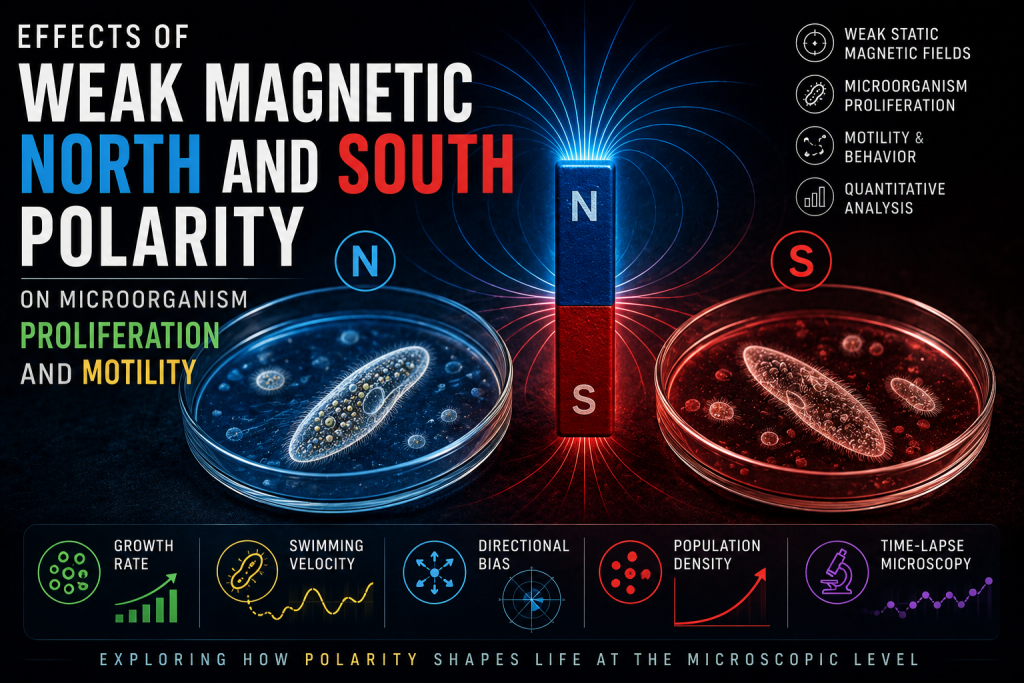
Magnetic fields are a persistent environmental factor that influence biological systems across multiple scales, from molecular interactions to organism-level behavior. Previous studies have demonstrated that microorganisms can respond to magnetic exposure through changes in growth dynamics, metabolic activity, membrane transport, and directional motility. However, the differential effects of weak magnetic north and south polarity exposure on microbial physiology remain insufficiently characterized.
This project investigates whether weak static magnetic fields of opposing polarity influence the proliferation and motility of microorganisms under controlled laboratory conditions. Model organisms including Paramecium spp., Saccharomyces cerevisiae, and selected bacterial strains will be exposed to low-intensity north-oriented and south-oriented magnetic fields generated using calibrated permanent magnets or Helmholtz coil systems. Sham-exposed controls will be maintained under identical environmental conditions without magnetic exposure.
Behavioral and physiological responses will be assessed through measurements of swimming velocity, directional bias, colony expansion, growth kinetics, and population density. Time-lapse microscopy and automated motion-tracking analysis will be used to quantify motility dynamics and collective behavioral changes.
Previous research suggests that magnetic fields may influence ion transport, reactive oxygen species (ROS) regulation, membrane potential, and intracellular signaling pathways. Magnetically induced changes in calcium flux and oxidative balance have also been proposed as mechanisms underlying biological sensitivity to weak magnetic environments.
We hypothesize that weak magnetic polarity conditions may induce measurable differences in microorganism proliferation and motility through subtle modulation of electrophysiological and biochemical processes. This work aims to contribute to the growing field of bioelectromagnetics by establishing reproducible experimental models for investigating weak-field biological interactions in simple cellular systems.
References
Binhi, V. N., & Prato, F. S. (2017). Biological effects of the hypomagnetic field: An analytical review of experiments and theories. PLOS ONE, 12(6), e0179340.
Martel, J. (2024). Effects of light, electromagnetic fields, and water on microorganism behavior. Progress in Biophysics and Molecular Biology, 186, 12–20.
Novák, J., Strašák, L., & Fojt, L. (2007). Effects of low-frequency magnetic fields on the viability of yeast Saccharomyces cerevisiae. Bioelectrochemistry, 70(1), 115–121.
Rosen, A. D. (2003). Mechanism of action of moderate-intensity static magnetic fields on biological systems. Cellular Biochemistry and Biophysics, 39(2), 163–173.
Shimizu, K., & Kato, M. (1999). Effects of magnetic fields on microorganisms. IEEE Transactions on Magnetics, 35(5), 5008–5010.
Usselman, R. J., Hill, I., Singel, D. J., & Martino, C. F. (2014). Spin biochemistry modulates reactive oxygen species production by radio frequency magnetic fields. PLoS ONE, 9(3), e93065.

MicroSwim Analyzer: Open-Source Real-Time Tracking for Microorganism Motility Research

Do Weak Electromagnetic Fields Help Plants Grow?
[ParaMot] Low-Frequency Electromagnetic Fields and Paramecium spp. Motility
About The Author
